Throughout the USA, Europe, Australasia and South America
IDEAL FOR SITE ASSESSMENTS
Save time and money in phase II environmental site assessments & excavations, soil remediation, dry-cleaner remediation projects, government agency compliance testing and training programs & monitoring remediation activities with our detect-oil-in-soil kits
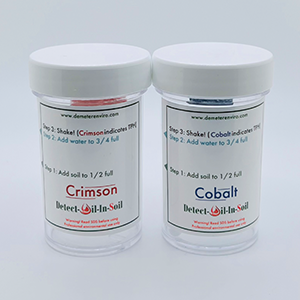
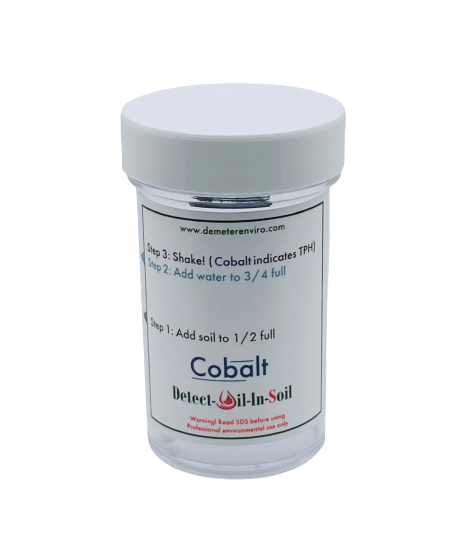
Each Detect-Oil-In-Soil test comprises a polystyrene jar and plastic lid, a water-soluble cube encapsulating an oil-staining dye & a small white polystyrene bead. The packaging includes a safety data sheet, an instruction booklet (SOP), a brochure, and a small plastic bag containing extra white beads.
Colors
The kit is available in three colors;
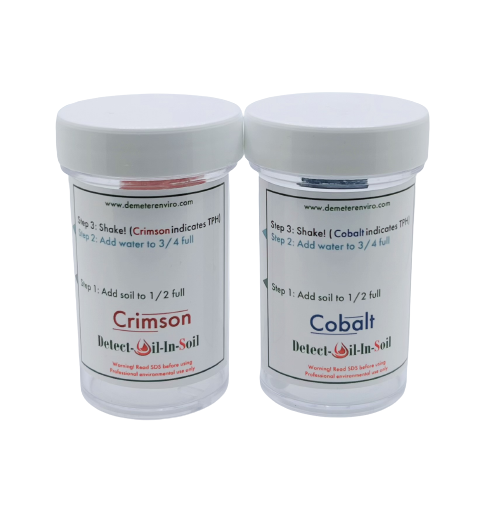
Crimson Detect-Oil-In-Soil
Sudan IV Detect-Oil-In-Soil
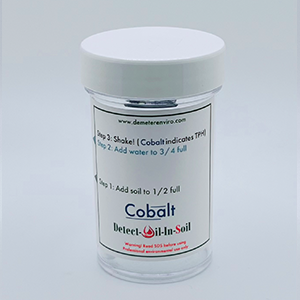
Cobalt Detect-Oil-In-Soil
Method
Using Detect-Oil-in-soil test is efficient and user friendly. The test jar should be filled to the indicator arrow (approximately halfway or 1 oz) with soil, with clean water being added to the second indicator arrow on the jar. The lid should be tightened, and the jar should be shaken until the cube stuck to the inside of the lid is completely dissolved (depending on which test kit you are using – crimson, sudan IV or cobalt)
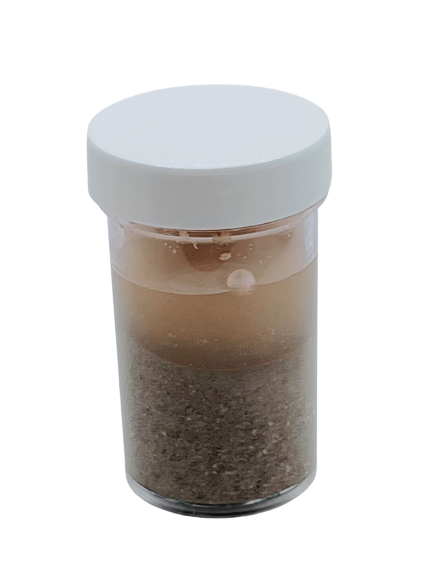
The more contaminants that are present in the soil, the more dye is produced, both in terms of quantity and intensity. The amount of dye (color presence and intensity) you observe corresponds to the petroleum concentration. Almost everyone with normal color vision is able to discern the color of the EPS bead at ~500 ppm tph. Veiw Galleryof test kits with contamination at ~500 ppm tph ~2500 ppm tph ~5000 ppm tph.
**Detect-Oil-In-Soil tests should be used exclusively to detect the presence or absence of contamination. Since every test is unique, these suggestions are simply intended as general guidelines.
Applications
Some examples of where Detect-Oil-In-Soil tests are used are as follows:
Oil leaks from the underground storage tanks
To find out if there is oil in soil near utility company transformers
To conduct Phase II ESAs – identifying the boundaries, depths, and directions of oil spills in soil
To test drill core samples for NAPL that cannot be seen or detected without the use of a photo-ionization detector
To detect chemical spills on commercial and industrial sites, such as dry-cleaning services and manufacturing plants
To differentiate between organic matter and suspected heavy oil in a core
To determine between emulsified floating organic matter and dielectric fluid when an underground transmission line discharges dielectric fluid.
Limitations
Oils and petroleum-based hydrocarbons are the ONLY substances that the Detect-Oil-In-Soil test can detect. Some of the new synthetic oils cannot be screened since they are typically ester-based rather than petroleum-based. It will only provide a “presence indicator” between ~400 and ~500 ppm TPH or above.
For the detection of gases (compounds with 4 carbons or less) or for usage with heavy bituminous materials like asphalt, Detect-Oil-In-Soil kits are NOT appropriate.
Sed ut perspiciatis unde omnis iste natus voluptatem accusantium doloremque laudantium totam reaperiam eaque ipsa quae ab illo inventore veritatis et quasi architecto beatae vitae dicta sunt explicabo.